Pinnacles of luxury in millionaire magnet Dubai, Singapore draws world’s richest too
DUBAI – In the ultra-luxury property market, wellness is no longer a lifestyle add-on but a design imperative, reshaping how homes are conceived, marketed and sold.
And few places showcase this trend quite like Dubai, which has become the No. 1 destination in the global migration of high-net-worth individuals, or those with liquid investable wealth of US$1 million (S$1.3 million) or more (Singapore ranks sixth – see table below).
The change is most evident in the super-prime segment, a category that typically refers to homes priced above US$10 million, though in Dubai, such properties now average closer to US$15 million.
Here, developments are increasingly defined not by chandeliers and other traditional signifiers of wealth, but by health- and wellness-focused design.
Among the most prominent upcoming projects are the Six Senses and SHA developments, part of Dubai’s fast-growing branded residences market. Both are integrating health and longevity clinics and medi-spas directly into residential towers and private islands.
Facilities once considered niche – hyperbaric oxygen chambers, cryotherapy suites and infrared saunas – are becoming standard requests among wealthy buyers.
And architects and designers are embedding wellness principles into the fabric of new homes with circadian-friendly lighting, mould-resistant and radiation-shielding walls, and advanced air- and water-purification systems.

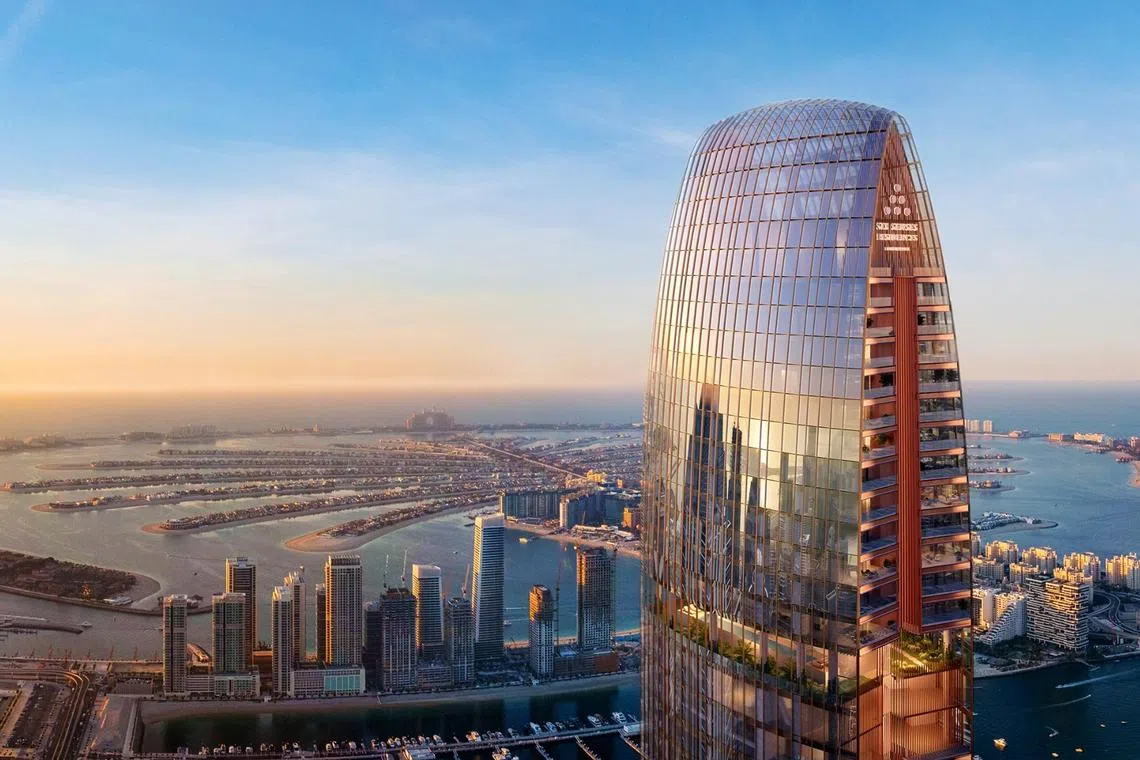
Six Senses Residences Dubai Marina’s walls are cladded to block electromagnetic fields that some believe can cause health and sleep issues.
PHOTO: SELECT GROUP
One of the most striking examples is the Six Senses Residences Dubai Marina, which comes from the Six Senses brand of luxury hotels and spas designed with a focus on sustainability and holistic health.
Scheduled for completion in 2028 and billed as the world’s tallest purely residential tower, it will rise 522m over 122 storeys, with 251 residences ranging from two-bedroom apartments to five-bedroom triplex “sky mansions”, serviced round the clock by concierges and butlers.
Even more impressive is the scale of the amenities, which occupy 61,250 sq ft (5,690 sq m) of the gross floor area of 116,000 sq m and are spread over four levels.
In addition to the usual recreational spaces one might expect, residents will have access to indoor and outdoor cinemas, a climate-controlled wine lounge and, on the 109th floor, a pool and gardens with sweeping views of Dubai and beyond.

Six Senses Residences Dubai Marina will have a skydeck with pool and sweeping views on level 109.
PHOTO: SELECT GROUP
But it is the wellness provisions that are truly exhaustive: infrared as well as Finnish saunas plus an ice bath; crystal sound-healing and salt rooms; and hyperbaric oxygen chambers – pressurised medical devices in which patients breathe pure oxygen to enhance healing.
Also on offer will be cryotherapy chambers, which blast the body with extremely cold air, said to reduce inflammation and promote recovery.
An on-site clinic operated by a doctor will also provide supervised pro-longevity treatments, including plasma-based rejuvenation therapies.
“This is a unique product that is not available anywhere else,” says Mr Georges El Hachem, commercial director at Select Group UAE, the developer behind this project as well as Six Senses The Palm, Dubai, due to open later in 2026.
“Everyone buying a home in this particular tower understands exactly that it’s a wellness building,” he adds. “It’s not just a regular residence. It is also a place where you can unwind and live in serenity.”
Prices for homes here start at 5.8 million United Arab Emirates dirham (S$2 million) for a two-bedroom, 2,000 sq ft apartment, and from 66.2 million dirham for a five-bedroom, 9,000 sq ft “sky mansion”.
Some of the pricey wellness treatments will be free for residents. These include hyperbaric oxygen therapy and cryotherapy, which can cost hundreds of dollars a session elsewhere.

Residents of the Six Senses Residences Dubai Marina will have exclusive use of an ice bath and sauna, as this rendering shows.
PHOTO: SELECT GROUP
The building also takes environmental health seriously. Walls are specially cladded to shield residents from certain electromagnetic fields generated by electricity and various forms of radiation – which some in the wellness space believe can be disruptive to sleep and health – while preserving full mobile connectivity.
“All the bedrooms and other internal rooms in the tower are isolated from microwaves and other frequencies that come from electrical equipment and might harm the body,” says Mr El Hachem.
“So, you will be sleeping in your bedroom having full connectivity to your phone, but your body will not be exposed to as much of that radiation.”
Mould prevention and air quality, common concerns in dense urban environments, were also factored into the design.
“The walls and ceilings are wrapped with rubber seal, so there is no mould creeping within the building, which is better for the respiratory system,” he says. Air-conditioning ducts have been modified so the filters in each home can be changed quickly and easily.
The building will also provide potable tap water throughout, a rarity in Dubai and the wider region.
A slightly different interpretation of wellness-led living is envisioned for SHA Residences Emirates Island, due for completion in 2027 and marketed as the world’s first private island dedicated to healthy living and longevity.

SHA Residences Emirates Island is marketed as the world’s first private island dedicated to healthy living and longevity.
PHOTO: IMKAN
Part of the SHA brand – which operates luxury resorts and clinics in Spain and Mexico and combines Western medicine with integrative therapies – the new development will be within the AlJurf coastal development, an enclave in the so-called “Emirates riviera” area between Dubai and Abu Dhabi.
Mr Michal Hansen, partner at Knight Frank MENA, the island’s sales partner, says today’s high-net-worth buyers are increasingly prioritising health.
“They want proximity to medical facilities as well as greenery, parks and natural landscaping,” he notes.
Nestled between white sand beaches and lush mangroves, the island promises to deliver all of the above.
Residents will have access to an on-site wellness clinic run by doctors and offering advanced diagnostics and personalised therapies. Restaurants will focus on healthy cuisine, with in-residence catering also available.
Homes – priced from 4.6 million dirham for an apartment and from 29.9 million dirham for a villa – will be organised around open-plan layouts suffused with natural light.
Interiors will make liberal use of natural materials such as wood and stone, alongside advanced lighting and air purification systems.
“There is smart technology that will constantly measure the air quality of the unit and add more filtration at different times,” Mr Hansen says.
And the lighting in each property will be circadian-friendly, or aligned with the natural 24-hour light-and-dark cycle. The idea is that this is conducive not just for sleep, but also for overall health.
The system will be dynamic and personalised, adjusting brightness and colour temperature to the time of day as well as residents’ habits.
“The lighting system will balance your circadian cycle, and it’s all curated around you,” he explains.
The growing importance of wellness to the well-heeled has not gone unnoticed among top architects and designers.
Mr Will Plowman, head of the Dubai office of architecture and design firm Foster + Partners, says this has become a near-universal part of the brief for high-end residential developments.
“The wellness part of it is definitely important, on the amenities side, and I think that’s a global trend,” he says.
This was part of the legacy of the Covid-19 pandemic, when people began working and spending more time at home.
“Post-Covid, the home office became a massive thing – and a beautifully designed office, not just a leftover space that becomes an office,” Mr Plowman says.
“People began spending more time at home, and so a home gym, sauna and ice bath are in almost every project now, whereas they were more of a one-off before.”
Ms Leigh Williamson, managing director at Sotheby’s International Realty in Dubai, has seen similar changes in buyer expectations.
For ultra-high-net-worth individuals – typically defined as those with a net worth or investable assets of US$30 million or more – design and architecture play an especially important role, particularly as many will purchase properties off-plan, before or while these are under construction.
Buyers, she says, look for top-name architects such as Foster + Partners or Killa Design Architecture, alongside high-end interior designers.
“And the amenities they want are often health-related because health is so important to them – so a good gym, a good steam room and a sauna,” she adds.
But she began seeing biohacking-type amenities – cold-plunge tubs, infrared saunas and red-light therapy beds – pop up in super-prime homes just in the last two to three years.
And she expects that trend to continue. “I just met a developer who’s going to develop one of the World Islands,” she says, referring to Dubai’s man-made archipelago shaped like a world map and still under construction. “And his whole theme and concept for it is biohacking.”
Also considered standard in high-end residential construction now is biophilic design, an approach integrating elements of the natural world into the built environment to improve health, well-being and productivity.
This is particularly salient in cities, such as Dubai, that grapple with extreme heat as well as air-quality issues.
As an example, Mr Plowman points to Foster + Partners’ work on The Lana hotel and The Lana Residences, Dorchester Collection.

The Lana hotel and The Lana Residences in Dubai feature deep recessed balconies to reduce heat gain.
PHOTO: FOSTER + PARTNERS
A waterfront luxury hotel and residence that opened in Dubai in 2024, its facade is punctuated by vertical gardens as well as deep overhangs and balconies, a design strategy to boost shade and reduce solar heat gain, lowering the need for mechanical cooling.
“The very early concept was: ‘How do we bring green spaces into the tower?’ So, we punched holes to allow these gardens to grow in shaded spaces.
“When you bring green into buildings, whether it’s a tree or more wood materials, we know that enhances the quality of the space, and makes people calmer,” says Mr Plowman.
“And in terms of air quality and flow, we know that both greenery and building next to water help.”

The Lana hotel and The Lana Residences in Dubai feature deep recessed balconies to reduce heat gain.
PHOTO: FOSTER + PARTNERS
A record 142,000 millionaires were projected to have relocated internationally in 2025, making this the largest global shuffle of wealth in a decade, according to a controversial wealth-migration report.
Published in June 2025 by Henley & Partners, an international investment migration advisory firm, the report put the United Kingdom at the top of the losers’ list.
Some 16,500 millionaires were expected to flee its shores in 2025, the biggest net outflow for any country in the decade the firm and its research partner have been collecting this data.
Western Europe more broadly was on the retreat, with key nations such as France (-800), Spain (-500) and Germany (-400) expected to see their first net losses, in a decade, of high-net-worth individuals – defined as those with US$1 million (S$1.3 million) or more in liquid investable wealth, excluding primary residences or property.
The United Arab Emirates (+9,800) and the United States (+7,500) were the top gainers, with Singapore (+1,600) in sixth place globally and still the main wealth magnet in Asia.
But the most shocking headlines from the report related to the UK, which it said was experiencing a historic wealth flight.
This was also the first time in 10 years that a European nation had led the world in this metric.
That said, there has been vigorous debate over the validity of the report’s methodology and the implications of its findings, especially when it comes to the UK.
But the exodus from the latter continues a multi-year trend. It is thought to have been exacerbated by recent tax reforms, including hikes in capital gains and inheritance taxes.
Dr Juerg Steffen, Henley & Partners’ chief executive, said the data suggests significant “long-term implications for Europe and the UK’s economic competitiveness and investment appeal”.
They also point to “a deepening perception among the wealthy that greater opportunity, freedom and stability lie elsewhere”.
And “elsewhere”, increasingly, means the UAE and US, after which the biggest magnets were Italy (+3,600), Switzerland (+3,000) and Saudi Arabia (+2,400), followed by Singapore.
The report cited Singapore’s “stable political environment, sophisticated and well-regulated financial sector, attractive tax policies and high standard of living” to explain its enduring reputation as a wealth haven.
In the Emirates, Dubai was the dominant destination, followed by Abu Dhabi, the draws here being low taxes, visa programmes for long-term residency, high-end lifestyle offerings and safety.
The key economies of Asia, however, remain paradoxes when it comes to millionaires.
China ranked second globally in net millionaire losses in 2025, when it was forecast to shed 7,800 of them, followed by India (-3,500) and South Korea (-2,400).
But this was China’s lowest net millionaire loss since the Covid-19 pandemic, and came after it topped the millionaire loser rankings every previous year of the past decade.
Relocations from China and India could also be driven in part by the region’s economic dynamism, and wealthy citizens’ desire to broaden their prospects by relocating.
And Asia as a whole continued to be the top region for wealth creation, with China and India’s millionaire populations each soaring by more than 70 per cent in the last 10 years.
-
Global Design is a series on design ideas and experiences beyond Singapore.
-
The writer’s trip was hosted by Dubai’s Department of Economy and Tourism.
link